
Pay Transparency and Pay Equity Solutions
Companies wishing to establish themselves as fair and modern employers cannot avoid addressing the issue of fair pay. In times of skills shortages and high expectations regarding employer attractiveness, transparent and fair remuneration offers a clear competitive advantage. Pay inequalities – whether perceived as such or actually present – undermine employee motivation and retention.
But what is the state of pay equity in your company? We help you assess the current situation, create transparency and actively work towards pay equity.
With our expertise, we guide you on the path to a fairer compensation system – from the initial analysis through to sustainable implementation.
The Lurse Pay Equity Services at a Glance

Compensation Dashboard
Get a comprehensive overview of compensation structures and transparency within your company – clearly laid out and at a glance.

Pay Equity Readiness Check
Assess how well your company is prepared for fair and non-discriminatory compensation.


Gender Pay Gap Market Reports
Receive in-depth analyses and reports on gender-specific pay gaps across various sectors.

Pay Equity Analysis
Receive comprehensive analyses on fair compensation regardless of gender, background or other characteristics.
Pay Equity Certification
Have your commitment to equal pay and fair compensation confirmed by an independent certification body.
Good reasons to take a closer look
In June 2023, a new EU directive came into force aimed at reducing the gender pay gap. It provides for binding measures on pay transparency and makes it easier for those affected to take legal action, for example by reversing the burden of proof in favour of employees. Among other things, reporting on the gender pay gap is also becoming mandatory: employers with at least 100 employees must publish information on the pay gap between female and male employees. The frequency of reporting and the due date for the first report depend on the size of the company. For example, the first data submission under the reporting obligation for companies with more than 250 employees is due in 2027 for the 2026 reporting year. You can read more about the planned measures on pay transparency here.
Any employer wishing to be perceived as fair and attractive should not wait for new laws to be introduced before taking action. Checking whether pay equity exists within one’s own company and how it can be achieved, if necessary, is a matter of sound corporate governance.
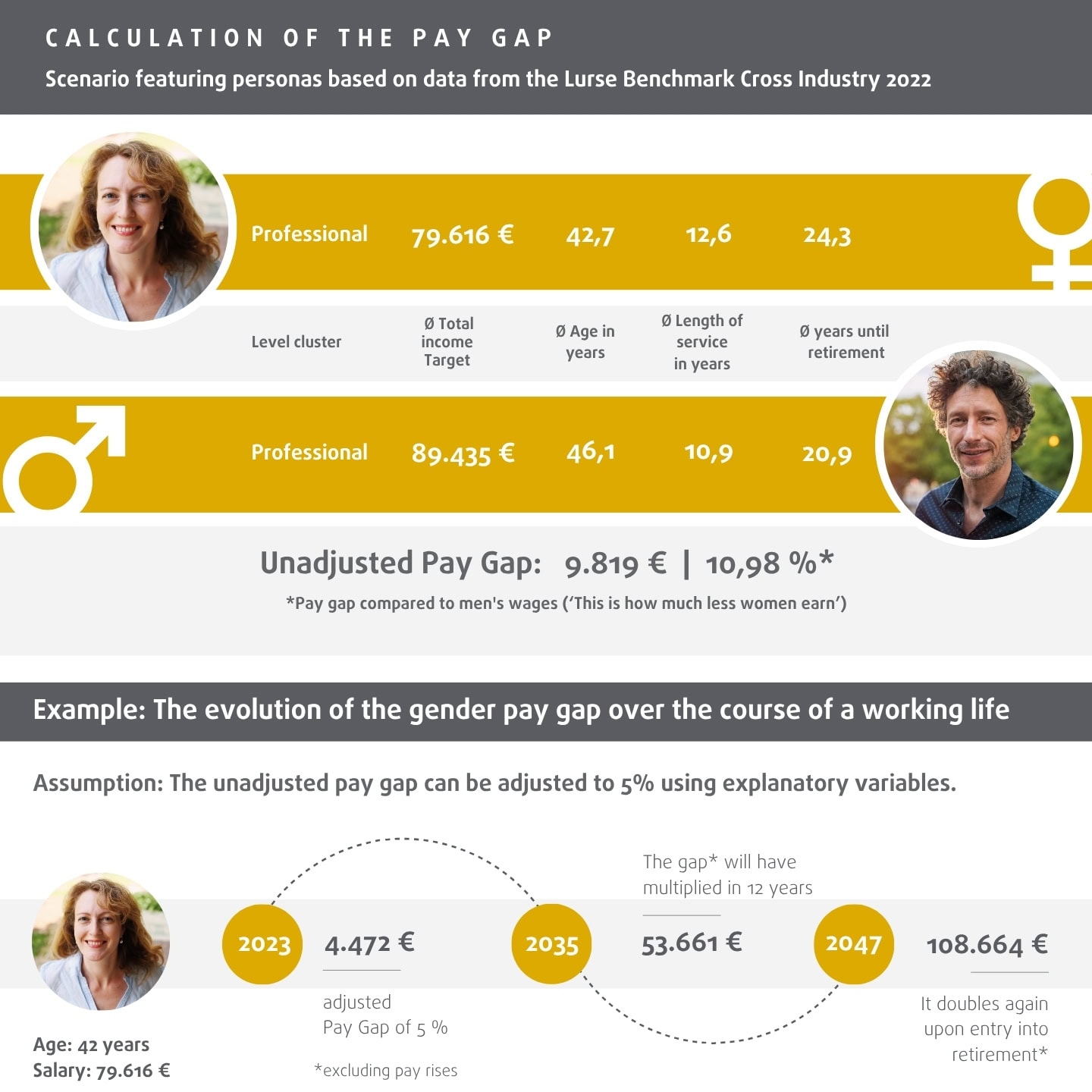
As part of the analysis, Lurse uses personal data to calculate the adjusted pay gap. This involves calculating that part of the pay gap between two comparison groups which cannot be attributed to explainable and justified differences. If the adjusted pay gap exceeds the tolerance threshold of 5 per cent, this is considered discriminatory under EU standards.
To calculate the pay gap, we use individual-level data collected by your organisation. This includes, for example, job grade/level, target achievement, performance appraisal, length of service, age or job family. The more objective and gender-neutral characteristics that can be included, the more meaningful the result. We assess the relevance of the data as part of the analysis.
To adjust for the pay gap, we apply the Oaxaca-Blinder method, which is also used by the Statistical Office of the European Union (Eurostat) for gender pay gap analysis. Regression analysis is a central component of the evaluation. This determines what proportion of the income differences between the comparison groups arises from differences in relevant, explanatory variables or characteristics, and what proportion remains unexplained, signalling a need for action.